13.00 Uhr
Rundgang
Share


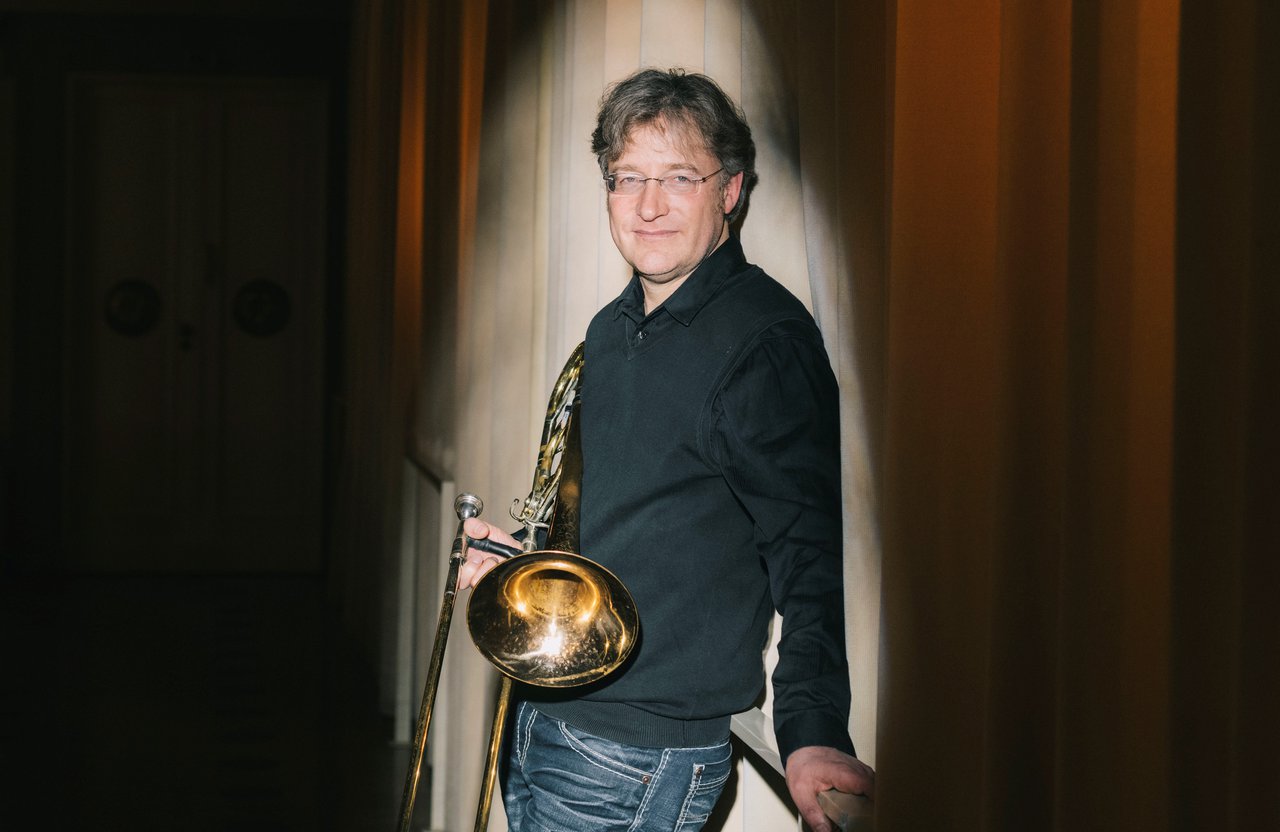 Helge von Niswandt, Porträt © Tobias Kruse/OSTKREUZ
I was about 10 years old, had already been playing the cello for five years, and wanted to learn another wind instrument. I ended up choosing the trombone because of its pitch and vocal quality, which are similar to the cello. Much to the chagrin of my mother, a cello teacher. Much later, I realized that the rich literature for cello is something very beautiful—what has been written for trombone is a bit more sparse.
Yes, as an orchestral musician with 25 years of professional experience, you don't set out for completely unknown shores quite as often. I've played Mahler's First about 60 times, for example. But many works are so complex that you can always discover something new in them or simply develop different opinions about them. Whether you retain this curiosity and alertness is ultimately up to you.
Mahler's First definitely has an unusual beginning that I find very interesting. I heard it for the first time when I was about 14. This tapestry of sound, which at first seems to float nowhere, was something completely new to me at the time. As a listener, you need a little patience – as a trombonist, too, for that matter: we have “tacet” as so often.
Procrastination is practically part of being a musician! There aren't many activities where the temptation to procrastinate is so great. That's because it's not immediately noticeable when you don't practice at all or only practice a little, perhaps only preparing for concerts and neglecting the big picture. It's a sweet poison that only really strikes after many years. But I've discovered a simple remedy: wherever I am, I first unpack my trombone and set it up. Then the next time I walk past it, I immediately start practicing—the biggest enemy is always unpacking.
There is still trombone literature that I know exists and that I really wanted to practice... and there is something I share with many classical brass players: we want to learn jazz improvisation. You can learn it, you just have to do it every day. And that brings us back to procrastination. It's not easy to find the time for it. But being able to do that would be a real plus for me.
I guess you have to learn it. I believe that perfectionists get good quickly at first. But at some point, their approach causes them problems. It's worth working on perfection, but when you're sitting on stage with 80 people, you can't get too neurotic about things that aren't exactly the way you imagine them.
Our former artistic director, Mr. Schneider, once said, “The composer is closest to God.” In an orchestra, you are a re-creative musician and play what is written in the score. It must be said, however, that over the decades, the way you play and want to play things changes significantly. In the end, you have to put your own feelings and ideas into it, otherwise the audience won't get anything out of it. But you are an executing element. That's why many of us do things like arranging, composing, teaching, or playing chamber music in our free time. Or they are creative and artistic in other ways. I think that's a very nice and necessary addition.
I don't think that has ever happened to me. It's an ideal, but at the same time it would also be a bit like the end. I was once really excited about a recording, which I assumed was our orchestra: “It's amazing how we do that. We've never sounded so good.” Then my daughter said, “Maybe it's not you!” I checked and had to admit she was right (laughs). I think as long as you're still searching for something, it's actually right. Being finished with a work is a strange ideal state that you strive for, but it's better not to achieve it.