13.00 Uhr
Rundgang
Share


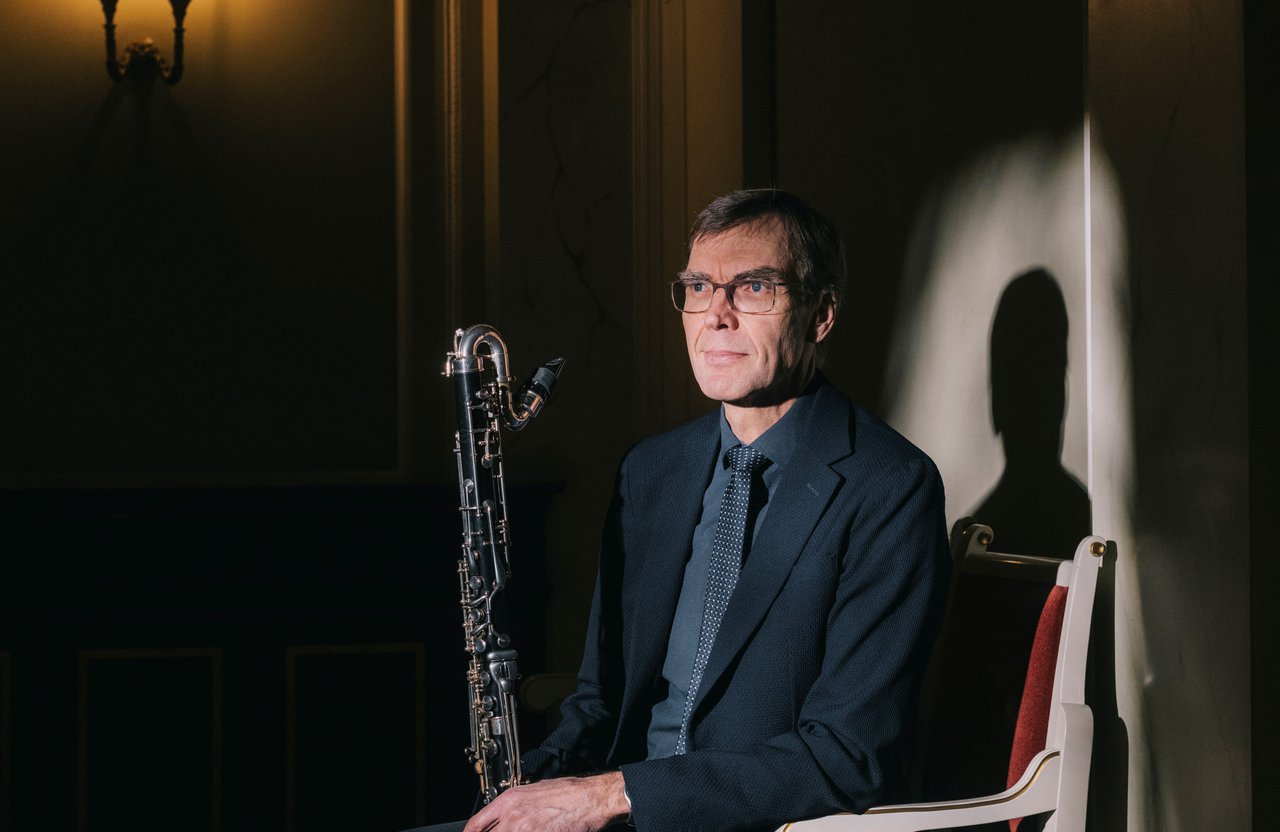 Norbert Möller, Porträt © Tobias Kruse/OSTKREUZ
I started playing the recorder when I was eight. When I turned ten, my uncle gave me a clarinet and I went to music school. Then it just continued relatively automatically with the clarinet throughout my whole life. I attended the special school for music [in East Berlin; ed.], which is now the Carl Philipp Emanuel Bach Music High School, transferred to the University of Music and was already a substitute [intern; ed.] in the Berliner Sinfonie-Orchester, now the Konzerthausorchester Berlin, during my studies. After that, I got the job there as a bass clarinettist. I have now been with this orchestra for 44 years – and I still enjoy coming here. With the concerts and the music I get to be a part of, I feel a bit like I'm on the island of the blessed.
I would never describe routine as an enemy. You gain experience – but unfortunately also the experience that pieces don't get any easier over the years. At the turn of the year, we played Smetana's ‘Moldau’ again. It's one of the pieces I've played most in my life, because it's in every request concert. It was an experience for me to see how our principal conductor Joana Mallwitz approached it a little differently: I've never played the piece so fast! But I really liked how much stringency it created. The Moldau didn't just babble along, it really came across as a river.
A top orchestra is characterized by the fact that, even in the first rehearsal, everyone plays the pieces as they could be played in concert – and the audience would probably say, ‘Great!’ But then we work on it together. To reach this level, you need enough individual preparation time. But you can't make up for lost time when practising. So I couldn't say, I'm going on holiday, I've got five days left afterwards, and I'll just practise for ten hours every day. That would never work, neither in terms of playing technique nor concentration or material [the clarinet reeds; ed.]. Of course, I also started practising in good time for ‘The Moldau’ at the turn of the year, because the beginning, with only two flutes and two clarinets, is always a challenge.
The one thing that's never finished for me is the photos. My family album for each year is four years behind – which isn't that much, I'd say. But the boxes of old photos that should have been sorted or stuck in albums long ago will remain there for a long time to come. On the whole, I've managed not to put off the things that were important to me: I love the mountains and always wanted to travel to the Himalayas. Instead of waiting until I was retired and might no longer be able to climb, I just did it.
When chaos arises in music because there is a lot of confusion in the orchestra, that is something we don't want at all! But there are pieces whose idea is to represent the chaos in the universe or the state of a chicken coop when attacked by a fox. In that case, the characterisation is marked ‘tumultuoso’. Basically, however, there is always a very strict order behind music. And the genius of Johann Sebastian Bach lay in finding completely new forms within this mathematical order.
As orchestra musicians, we contribute our voices, but we have to fit in with the conductor's interpretation. In this respect, it can happen that I actually perceive a passage differently, would play it faster or slower, or approach it differently in terms of character. But I have to accept what the conductor specifies. Individuality takes a back seat. When we play chamber music, we can be more creative. When teaching, I try to encourage students to develop their own ideas, while making sure in the background that everything fits together coherently. But I don't want to do what I learned – where the professor dictates every detail and writes it down with a thick pencil.
When you listen to CD recordings by the same conductor who has re-recorded a work ten or 20 years later, it is very interesting to hear how big the differences are. In that respect, every piece is always new. Because the Konzerthaus Orchestra was strongly influenced by Kurt Sanderling in its interpretation of Shostakovich, there used to be older colleagues who insisted on this and said that it had to be exactly that way. I always thought that when a younger conductor comes along, he should be allowed to do it differently.