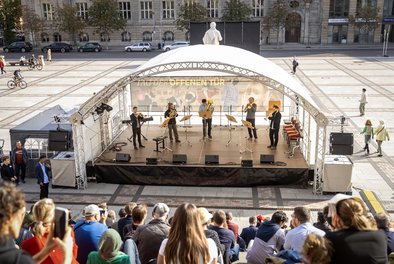
13.00 Uhr
Rundgang
Share


I started my musical life in a children's choir. In my home country of Denmark, I attended a music school where we could try out different instruments as a minor subject. I really liked the double bass. I started learning it and now I'm here at the Kurt Sanderling Academy (laughs). This is the first interview of my life.
I recently played in the Konzerthaus Kammerorchester for the first time. That made a big impression on me. We played Richard Strauss's ‘Metamorphoses’, in which all 23 musicians are responsible for their own solo part. I listened very carefully to each of my colleagues. In a smaller ensemble, you can express yourself much better as an individual musician than in a large symphony orchestra. I've played the piece several times before, but it feels completely new every time in a new constellation.
‘Metamorphoses’ has a very special beginning: the cello and bass come from the depths, and everything else develops from there. And it ends in the depths again. The story this piece tells is very close to my heart.
Sometimes, but not always. I know I need to work on my patience. As an orchestral musician, you need a lot of patience because it's always about finding a collective expression. But I can only take responsibility for my part as part of the whole. If something isn't quite perfect during rehearsals, I have to be patient until everything comes together so that unfinished music becomes finished music.
The short answer would be: I haven't finished my master's degree yet. But I think there's a lot I haven't finished yet. And also a lot I don't want to finish. I did my bachelor's degree a few years ago and today I feel almost less finished than I did at 18 when I had just started my studies. I think life as a musician is a long journey that is never finished. It's about constantly discovering something new – musical truth, perhaps, even if that sounds a bit clichéd (laughs).
After a chamber music project, I find that I am more inspired when I sit back in the orchestra a few days later. It's not that I want to decide everything myself then, but I feel more inner freedom. Yes, that's it. But you also have to be careful not to take too much freedom, because that can ruin the ensemble playing.
I feel that I have never perfected a piece. You can always find a different, more beautiful colour. I am a student anyway and am still searching. But I also believe that I will never feel that way, even in many years. Nevertheless, at some point I'm always on stage and have reached a certain point and try to simply give myself the freedom to play. Doubts and questions belong in the practice room. That's where they definitely help me progress. On stage, I can't have questions, I have to give an answer. Next time, it may be a different one.