13.00 Uhr
Rundgang
Share


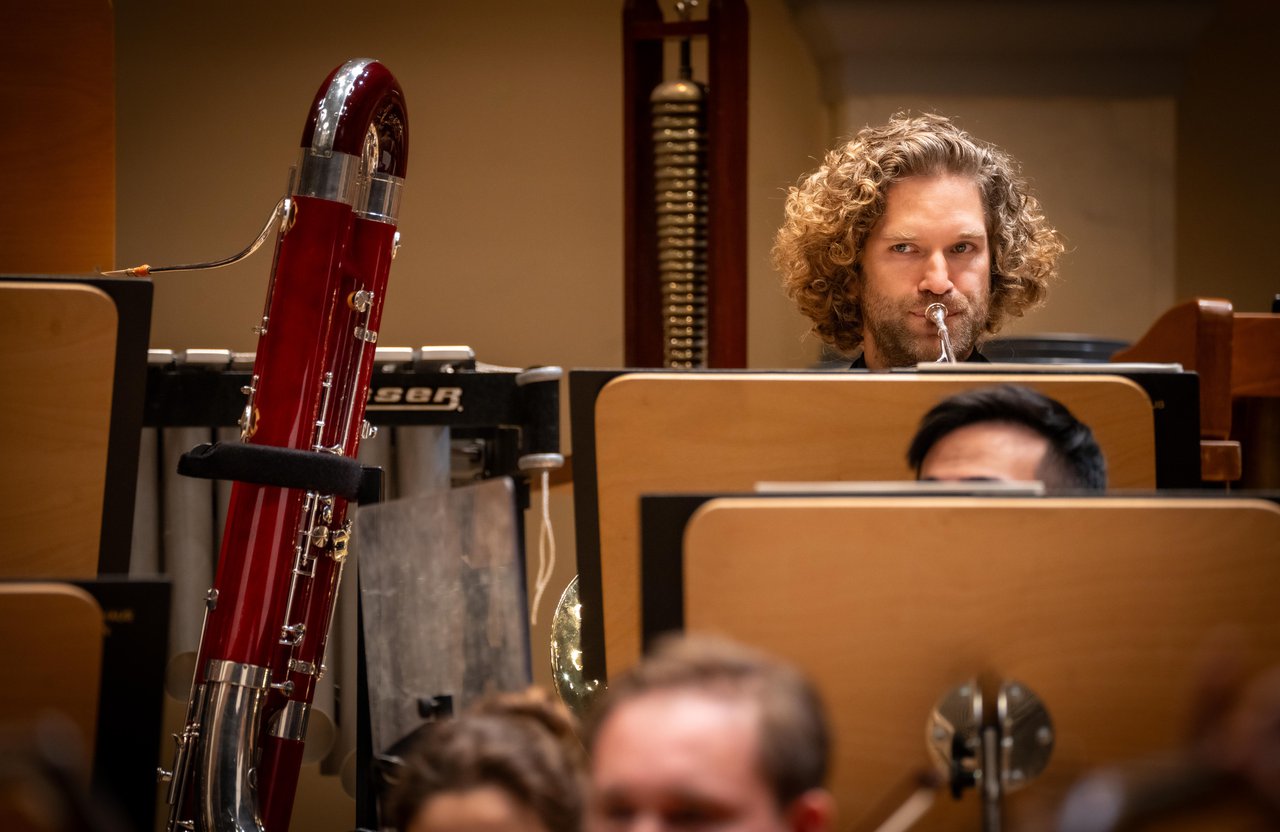 Hornist Timo Steininger © Marco Borggreve
In a letter from his summer retreat in the Bavarian Alps in July 1898, Richard Strauss wrote about his new tone poem, which was “of considerable length” and inspired by Beethoven's “Eroica” in terms of both theme and scope. His “Heldenleben,” the composer continued, did not include a funeral march like Beethoven's, but it did use the same key, E-flat major, and “a great number of horns, which are calibrated for heroism.”
As a horn player's son, Strauss not only gave his father's instrument two wonderful concertos, he also liked to feature it prominently and lavishly in his orchestral works. In “A Hero's Life”, there will be eight of them.
Our horn section therefore always looks forward to weeks when Strauss is on the programme. So soon after the summer break, it's almost like a class reunion!
Because five trumpets, four of each of the woodwinds, a large string and a full percussion section (plus a couple of other instruments) are also required, the Konzerthausorchestra will fill the stage to capacity.
A true hero does not hide: horns and cellos in unison immediately launch into his first theme! As is familiar from epics and legends around the world, he gets into a dispute with “adversaries,” finds and ensnares a “companion” – whose voice is the violin of our 1. Concertmaster Sayako Kusaka – fights on the “battlefield,” and accomplishes all kinds of “works of peace” for the good of humanity. Finally, he chooses “retirement from the world and completion” in the spiritual sphere.
But why were there critics who accused the composer of having a “monstrous ego” in view of this both archetypal and anachronistic life journey?
Well, he was not stingy with allusions that the capricious “companion” in the second movement corresponded to his diva of a wife. Furthermore, in „The Hero's Works of Peace“, numerous musical quotations from great works by Richard Strauss himself are cleverly hidden in the flood of material. His opponents found this incredibly arrogant. Their mood did not improve when they heard the hero's “adversaries” set to music by the woodwinds in a “very sharp and pointed, snarling, hissing” way, according to the score. This recognition, in turn, may have pleased Strauss greatly.
However, their assessment of his ego was not entirely wrong: “I don't see why I shouldn't compose a symphony about myself. I find myself just as interesting as Napoleon or Alexander,” the maestro declared – possibly with a quantum of irony..
Five years later, Richard Strauss conducted an enormous orchestra with the premiere of his “Sinfonia domestica” at Carnegie Hall. Highly imaginative instrumentation was used to put to music an ordinary day in the life of the Strauss nuclear family of three.