13.00 Uhr
Rundgang
Share


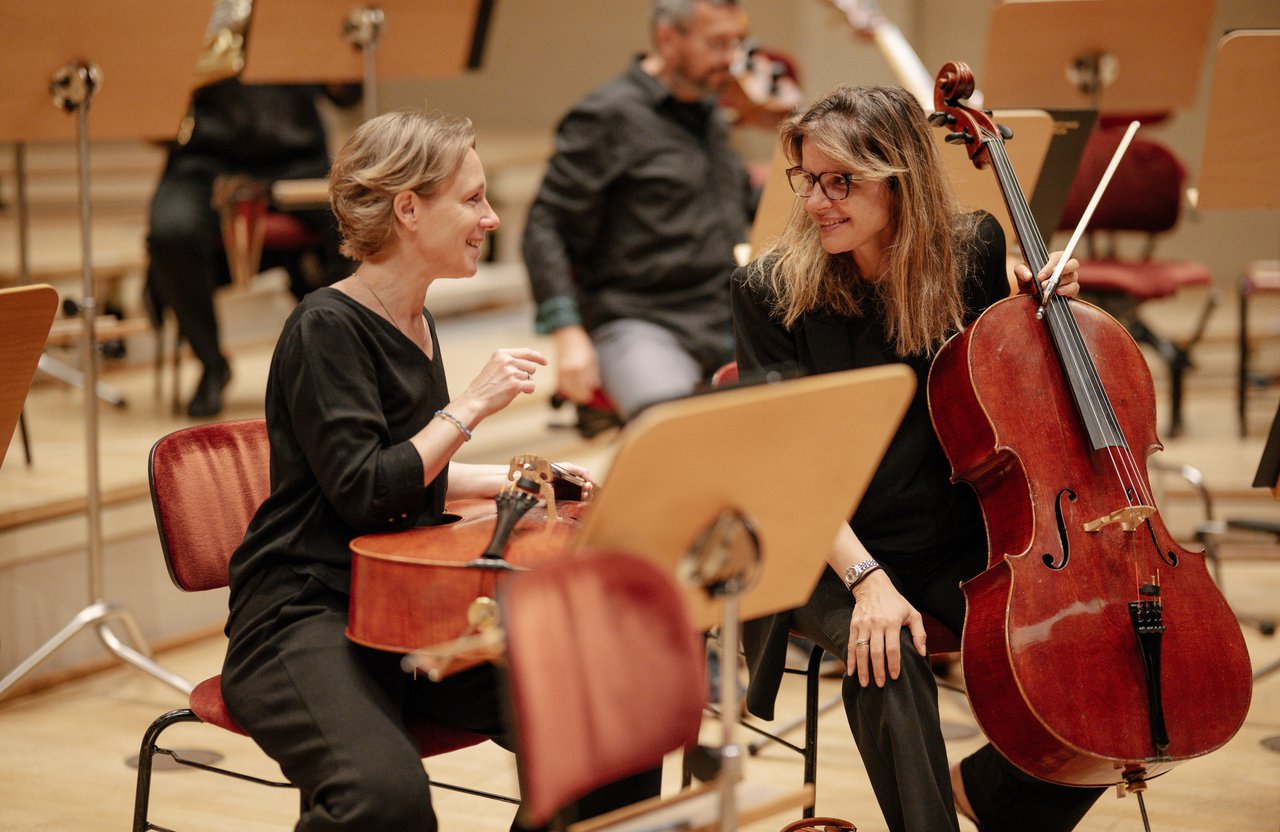 © Simon Pauly – Viola Bayer & Nerina Mancini
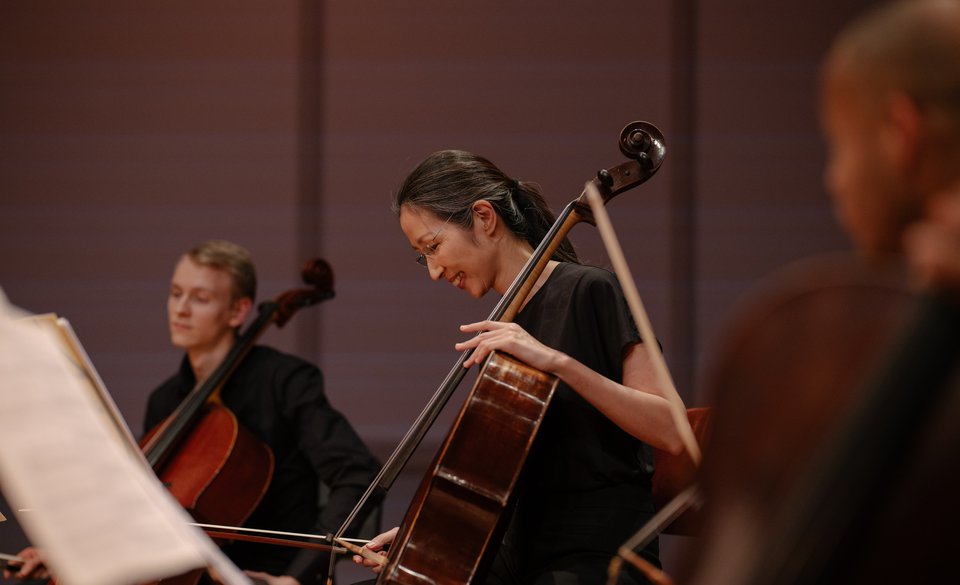
Our principal piccolo player Daniel Werner and cellist Jae Won Song are looking forward to an unusual chamber music ensemble: on 24 October, they will be playing works for string trio and piccolo with three colleagues, violinists Petr Matěják and Hitoshi Ooka and violist Ayano Kamei. They will also perform a string quartet by Puccini – the opera specialist is rarely heard at our concert hall.
“There is actually original literature for piccolo and strings,” confirms Daniel Werner. “For example, the quartet by Allan Stephenson that we are going to play. It is contemporary, but very classically structured, with a first movement featuring exposition and development and a beautiful slow second movement.” Jae-Won Song reveals that their choice of instrumentation has a personal background as well: “I was so surprised by Daniel's beautiful piccolo sound when he first joined us in the orchestra– it's like singing when he plays. We've become good friends, and he often visits me and my family. When we could only talk on the phone during the pandemic, he told me he was listening to Mozart's Oboe Quartet a lot and would like to play it. At first, I was sceptical about how that would work with the piccolo. Later, I thought, ‘Why not?’”
“There is only one recording in this instrumentation,” says Daniel. “But I think the piece suits the piccolo just as well as the oboe. And it helps to dispel the preconception that this small instrument is always loud and high-pitched. Incidentally, I get the greatest pleasure when I get to play passages together with the strings in the orchestra, as I did recently in Boléro – I love that colour.”
“And I enjoy playing with wind instruments,’” adds Jae Won. “You experience first-hand that music is breathing. For us string players, that's just as important.”
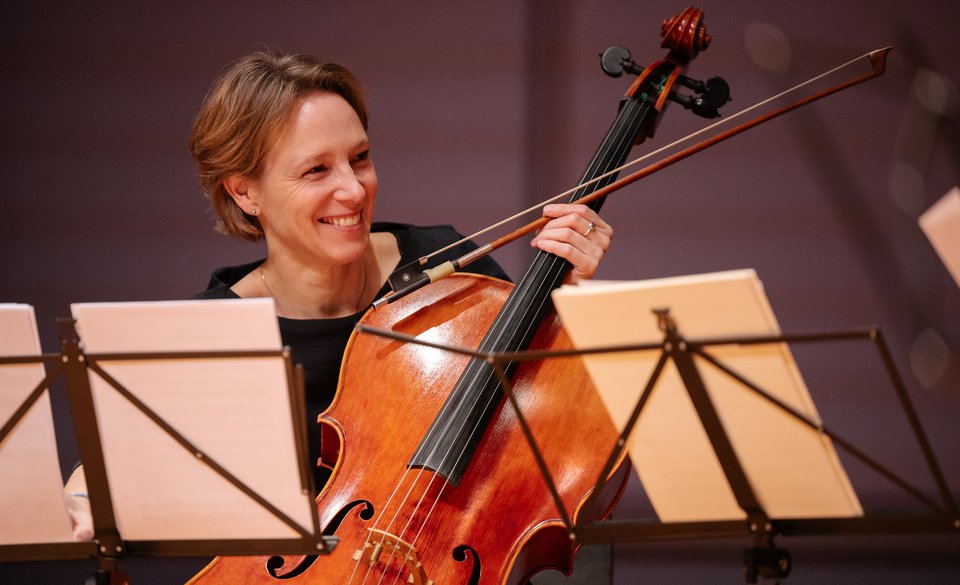
Our Konzerthaus Chamber Orchestra begins its season on October 30 with a particularly ‘concentrated’ line-up, featuring string sextets by Brahms and Strauss and a string quintet by Mozart. Cellist Viola Bayer, a member of the board of the member-run ensemble, explains why she is particularly looking forward to this concert:
We have been playing together in the Konzerthausorchester for many years and also regularly in the Konzerthaus chamber orchestra. If we play in a very small ensemble like this evening, it is especially gratifying that we already have so much common ground musically. There are hardly any string quintets or sextets as permanent freelance ensembles, because far fewer pieces have been written for them than for string quartets. So, usually a quartet brings in one or two musicians from outside, which means it has to find a new balance first. But it's very worthwhile, because among the pieces written for two violins, two violas and two cellos are such wonderful classics as Brahms' first string sextet. And discoveries such as the ‘Capriccio’ sextet from Richard Strauss' opera!
“I think Brahms's first string sextet is simply magnificent and I can't say which movement or passage I like best. The whole beginning sounds like a big hug. Brahms was only 27 when he wrote it, and the different emotions that stirred him – love, pain, joy – can be felt within the first movement, which then fades away quietly in pizzicato. I think he was able to express this with a depth, subtlety and love like no other. For us musicians, it is indescribably beautiful to recreate this feeling in our playing and pass it on to those who listen to us.”
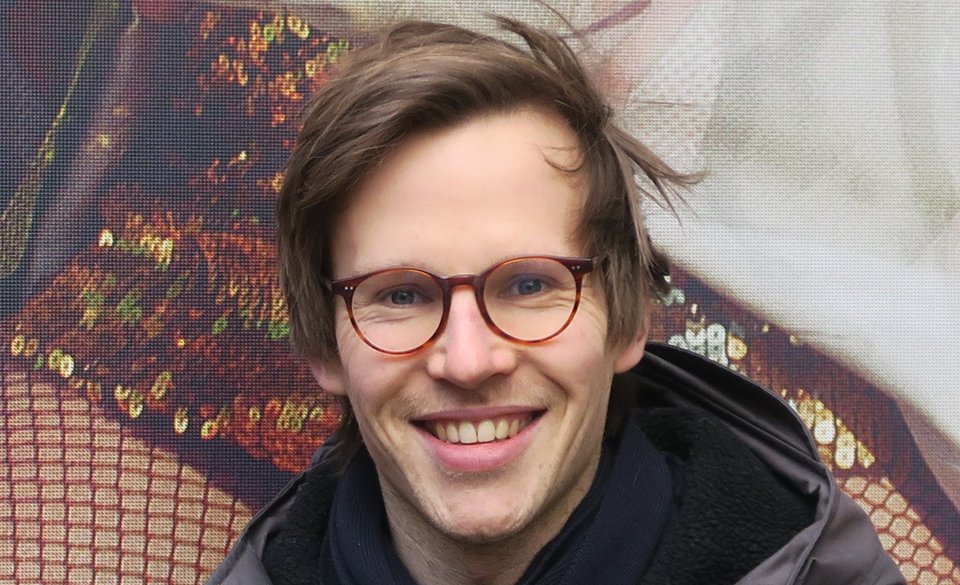
The first episode of ‘Herz über Kopf’, our new salon series hosted by actor Charly Hübner, is recommended by dramaturge Johannes Schultz on November 4:
"I am very much looking forward to our new salon, which we have developed with Charly Hübner. The first episode is about the US and Europe – a relationship that is currently reaching new lows almost daily. It is very frustrating to see how Trump is transforming the US into an authoritarian state and declaring Europe an enemy economically, politically and culturally.
At the Konzerthaus, we will explore the old transatlantic relationship, naturally starting with music: Charly Hübner will talk about Dvořák's symphony ‘From the New World’ and Gershwin's ‘An American in Paris’ – works that the Konzerthaus Orchestra will perform a few days earlier with Joana Mallwitz. And we have two guests with transatlantic biographies: journalist and US expert Rieke Havertz, whose podcast ‘OK, America?’’ I highly recommend, and American tenor Ted Schmitz, who now lives in Berlin.
I find it fascinating that the musical connections between the US and Europe are not limited to the influence of American jazz and popular music since the 20th century. They are also much more subtle. Ted Schmitz will bring a song by the English composer Benjamin Britten that inspired him to come to Europe. Britten, in turn, spent three years in New York at the beginning of the Second World War. However, he had great difficulty fitting in there – partly because, unlike many of his fellow American composers, he had not studied in Paris with Nadia Boulanger! The fact that Britten felt the old rivalry between England and France in America of all places is one of many, perhaps unexpected, examples of how transatlantically interwoven the music industry already was at that time."