13.00 Uhr
Rundgang
Share


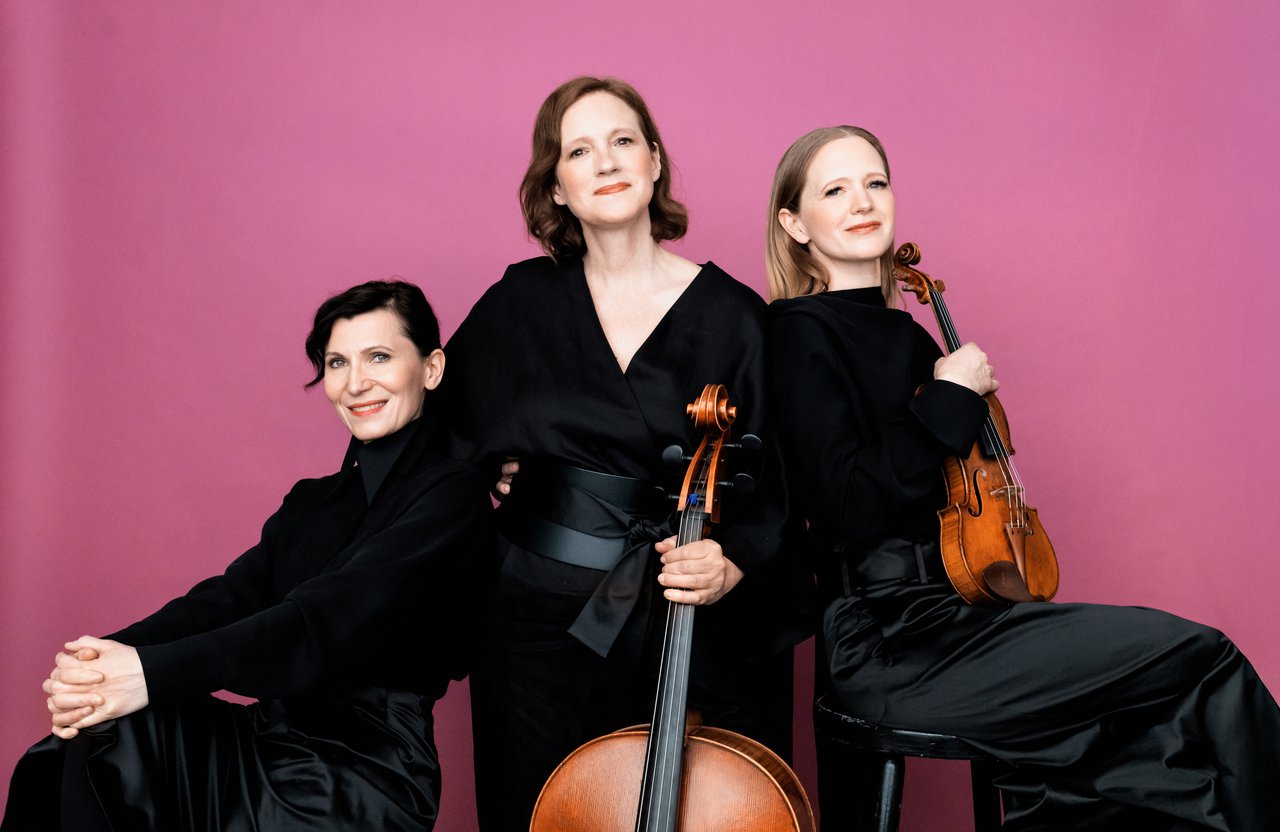 © Mathias Bothor
Pianist Karla Haltenwanger and cellist Ilona Kindt, who together with violinist Birgit Erz have formed the Boulanger Trio since 2006, about the work and legacy of Nadia and Lili Boulanger.
“We really wanted to find a name that meant something to us. It was a nice coincidence that Karla had played pieces by Lili Boulanger with a flutist the day before our very first meeting.
This prompted us to investigate whether Lili might also have written something for piano trio. In fact, there are two wonderful pieces – ‘D'un matin de printemps’ and ‘D'un soir triste’ – which had not yet been published at that time. We began to find out more about Lili and her sister Nadia Boulanger. This brought two of us full circle in a personal way: Karla's former piano teacher in Romania was a ‘granddaughter student’ of Nadia Boulanger, and Ilona studied at the Menuhin Academy. Yehudi Menuhin was a close friend of Nadia's.
We found the sisters so impressive that we thought, ‘That's the right name for us – but we really have to name ourselves after both of them!’”
“Nadia Boulanger was incredibly supportive of her younger sister's impressive blossoming talent. Lili went on to become the first French female composer to be awarded the Prix de Rome. After her sister's untimely death, Nadia continued to perform her compositions. She wanted to pass on this work and very consciously took a back seat to her own creative endeavors by no longer writing anything herself. This obviously felt right to her. Nadia was a passionate pedagogue. She found her place by teaching and passing on her knowledge. She was also a conductor and the first woman to conduct the Boston Symphony Orchestra. This was a sensation at the time.
Lili's works are now played everywhere. We are delighted that her two trio pieces are now part of the repertoire of many piano trios. And we also receive frequent requests from young ensembles for our song arrangements from ‘Clairières dans le ciel’.”
“She was a combative, strong, very assertive woman with strong convictions, whom not everyone got along with. Everything she did was incredibly profound and well thought out. As a composition teacher, she didn't just let her students write something; with her, composition and harmony really had to be learned from scratch. Bach was most important to her and was much discussed and played in her famous salon.
From the 1920s until almost her death in 1979, she invited people to her home on Wednesdays. This regular gathering, affectionately known as the ‘Boulangerie,’ was an institution in Paris and by no means a bohemian event. It was entirely devoted to music, work analysis, and composition lessons. In addition to her composition class, friends such as Leonard Bernstein, George Enescu, and Yehudi Menuhin also stopped by.
Nadia Boulanger was highly regarded for her attentive listening, her incredible knowledge, her intellect, and her vision. She encouraged many people and guided each of her students on their own unique path. Among the composers she taught were Marion Bauer, Grazyna Bacewicz, and Thea Musgrave.”
“In the first concert on Wednesday, we will be guests at the inspiring ‘Salon Boulanger’ compiled by Volker Hagedorn, which musically and narratively spans the lives and surroundings of the two brilliant sisters. We'll play not only as a trio then. Karla, for example, will play a few of Nadia's piano compositions, but also a work by Claude Debussy with an unusual background: at the end of his life, the composer was in dire financial straits. He ordered heating coal and was unable to pay for it. However, the coal merchant left it there anyway. In gratitude, Debussy wrote him a short piano piece. He never heard it—his heirs found it 84 years later.”
“On Saturday, we will focus on some of Nadia Boulanger's many outstanding students. Their music is actually completely different, but what they all have in common is the incredibly solid craftsmanship that Nadia Boulanger imparted to them. This clarity, this structural thinking, is highly noticeable. Since our recording in 2021, we have discovered much more, and we now want to revisit some of it.
First, we'll play a fresh trio by Jean Françaix, who studied with her as a very young man, then Aaron Copland's ‘Vitebsk,’ an intense, powerful piece that transitions into a wild dance. Leonard Bernstein contributes themes from ‘West Side Story’. He met Nadia late in life and was not a student, but he cultivated a close friendship with her and showed her all his works.
Quincy Jones, who wrote the theme music for The Color Purple, was not allowed to compose for strings in the USA at the time because of his skin color. His time in Paris with Nadia Boulanger was enormously liberating for him, because she accepted him just as he was, like any other student. Until his old age, he spoke and wrote about her with great affection and respect.
After Philip Glass's ‘Head On,’ a short but very cool minimalist piece, we play Astor Piazzolla's ‘Seasons’. He had previously studied in Buenos Aires with Alberto Ginastera and was eager to become a good symphony and sonata composer. So, he came to Paris with a scholarship and a suitcase full of sheet music. But Nadia was completely unimpressed by its contents. She tried to find out what his musical language actually was. At first, he didn't want to tell her that he played the bandoneon in tango clubs back home because he was really afraid that she would kick him out. Finally, he admitted it and played her a tango on the bandoneon. She said, ‘That's your path!’ That's how Nadia was. And that's how tango nuevo came into being.”