13.00 Uhr
Rundgang
Share


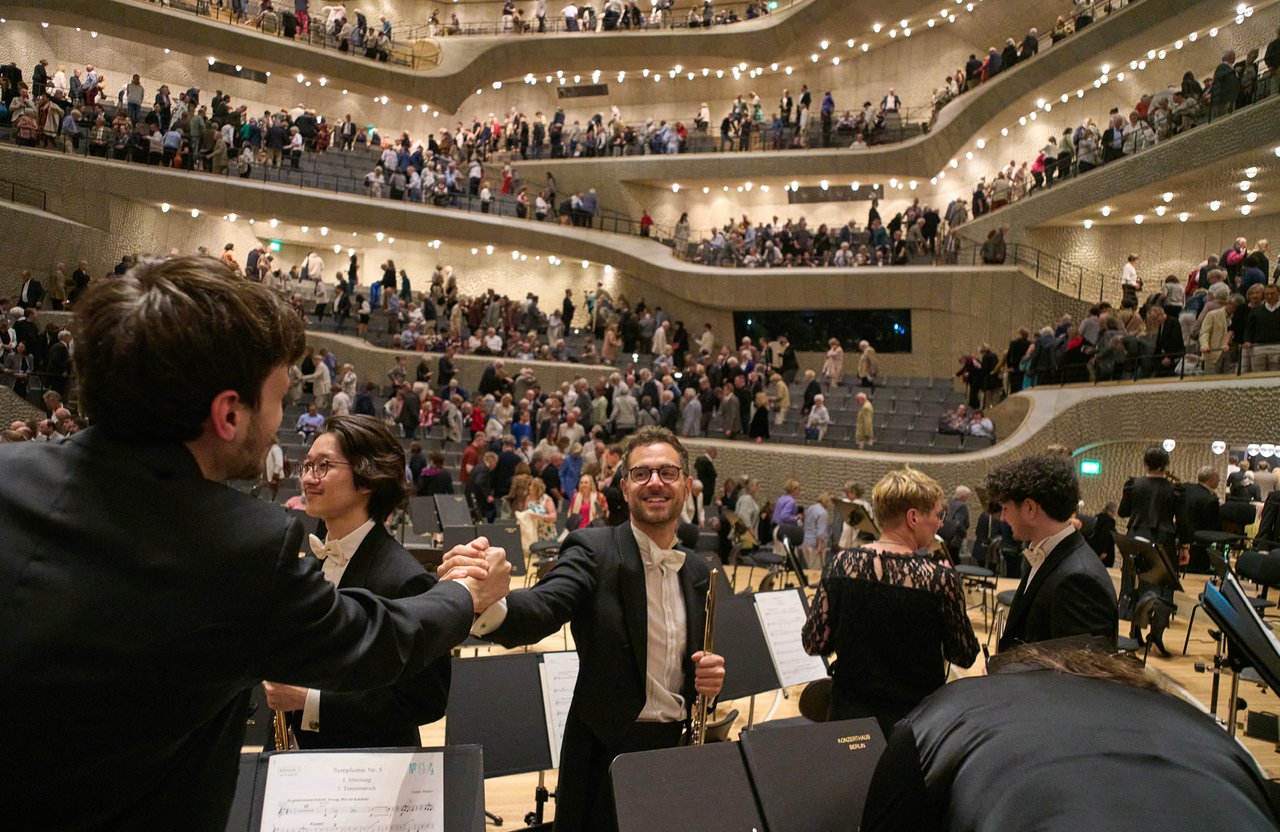 Das Konzerthausorchester in der Elbphilharmonie © Ralf Forster
Six concerts in seven days—from Hamburg to Linz and from Nuremberg to Cologne, the Konzerthaus Orchestra, Principal Conductor Joana Mallwitz, and soloist Alice Sara Ott are on tour. On the programme: Beethoven’s Piano Concerto No. 3 and Mahler’s Fifth.
Our soloist, Alice Sara Ott, has “always been drawn very much” to minor keys. That is why she particularly loves Beethoven’s third and only piano concerto in a minor key. “Here, you can also hear just what a brilliant composer Beethoven is, because the second movement of his C minor concerto is in E major. For me, this key has something very, very intimate about it—something otherworldly, non-human, and at the same time very human. E major stands in extreme contrast to C minor. They are keys that are not at all related to one another. If you can hold the tension from the last note of the first movement in C minor and then resolve the whole thing into E major, if both the musicians on stage and the audience participate, and together you endure this silence and this incredible tension and together immerse yourselves in this E major—these are moments that are specific to Beethoven and that make this piano concerto so magical.”
4m4P” is listed first in the instrumentation for Mahler’s Fifth Symphony—the abbreviation for “four flutes with four piccolos.” In Hamburg, between the dress rehearsal and the concert, we asked our flute section when the four of them would take their places in the upper register of the orchestra.
Principal piccoloist Daniel Werner laughs: “With Mahler, that doesn’t just happen in the Fifth. In fact, there are only two measures in this symphony where we all have to play the piccolo together. Those are the last two in the third movement.” “At this point, he’s looking for a special expression, a color, something bombastic,” interjects colleague Antje Schurrock. Daniel nods. “Especially this conclusion of the scherzo, this shrillness, has a different effect than when we all just play it in the upper octave of the flute. The timbre is different, after all. In his First Symphony, for example, Mahler writes a pure piccolo doubling for the entire final movement. That means two of us play the fourth movement in unison—absolutely the same thing. That’s very tricky, because the point, of course, is to blend very well. It should sound like a single piccolo, only with special power.”
The two musicians meet to “ine-tune this: “You have to experiment a bit. Our academy student Giorgio Bani, with whom I played the First, now owns an instrument from the same luthier as I do. That makes it easier, too.”
Everyone agrees that composers use the piccolo because of its distinctive timbre—sometimes shrill, sometimes radiant, like the crowning note in a chord: “It’s the flashlight of the orchestra,” said the teacher who taught me my first flute notes, Antje recalls. “I’ve never forgotten that, because it’s so spot-on!”
Our principal clarinetist, Ralf Forster—who took most of the photos on this tour—doesn’t just capture his colleagues at just the right moment time and again. Whether in Bielefeld, Hamburg, neon-lit snack bars in China, or Tokyo, looking tiny in the morning mist from the Skytree—whenever a few hours open up in the packed daily routine of touring between travel and rehearsals, Ralf immediately sets off with his camera.
This was also the case on the hot summer afternoon before our second concert—we accompanied him to the former Zollverein Coal Mine Industrial Complex in Essen. The massive lines and surfaces of the industrial monument and UNESCO World Heritage Site, soaring into the sky, immediately fascinate him. What gives the musician that thrill when taking photos?
“You can portray things in your own light, through your own eyes, and still leave them in reality. When you look at your own pictures, you get back to that moment in time, you can recapture the feeling you had then. I think that’s great. And if you’re good at it, that rubs off on others. It’s similar to making music. In music, the composer sets the tone; in photography, it’s the environment—but in both, you can apply your own filter without taking yourself too seriously.” For him, post-processing is a natural part of the artistic process; it’s by no means a chore—quite the opposite.
“When it comes to my photography on tour, it’s both enjoyable and important to me to portray the orchestra in an artistic and appealing way,” he sums up. Whether it’s photography or music – based on what we’ve observed, both seem to give Ralf a sense of flow and plenty of energy.
While the orchestra members are still working through restaurant reservations, going for a jog, warming up their embouchure, or taking a quick nap, the team led by our coordinating orchestra manager Dirk Beyer and his colleagues Gregor Beyer, Raphael Volkmer, and Niels has long since been hard at work. They are always the first to arrive and the last to leave.
Local stagehands help unload our instrument shipment. Their knowledge of the area is invaluable, as every venue is laid out differently and has its own unique features when it comes to access points, storage options, and procedures.
Chairs and music stands are moved, timpani are rolled in, the double basses are freed from their bulky travel cases and carefully placed on stage, and sheet music is distributed. Soon everything is exactly where it should be.
When the musicians arrive, the same questions need to be answered for them in the winding backstage corridors at every tour stop: Where is the case with my instrument, where is the stage, where are the dressing room lockers, are the basics provided—water dispensers and, ideally, a fully automatic coffee machine—or do I have to go looking for the cafeteria? Once everything has been found, the hall’s acoustics are tested on stage during the sound check.