13.00 Uhr
Rundgang
Share


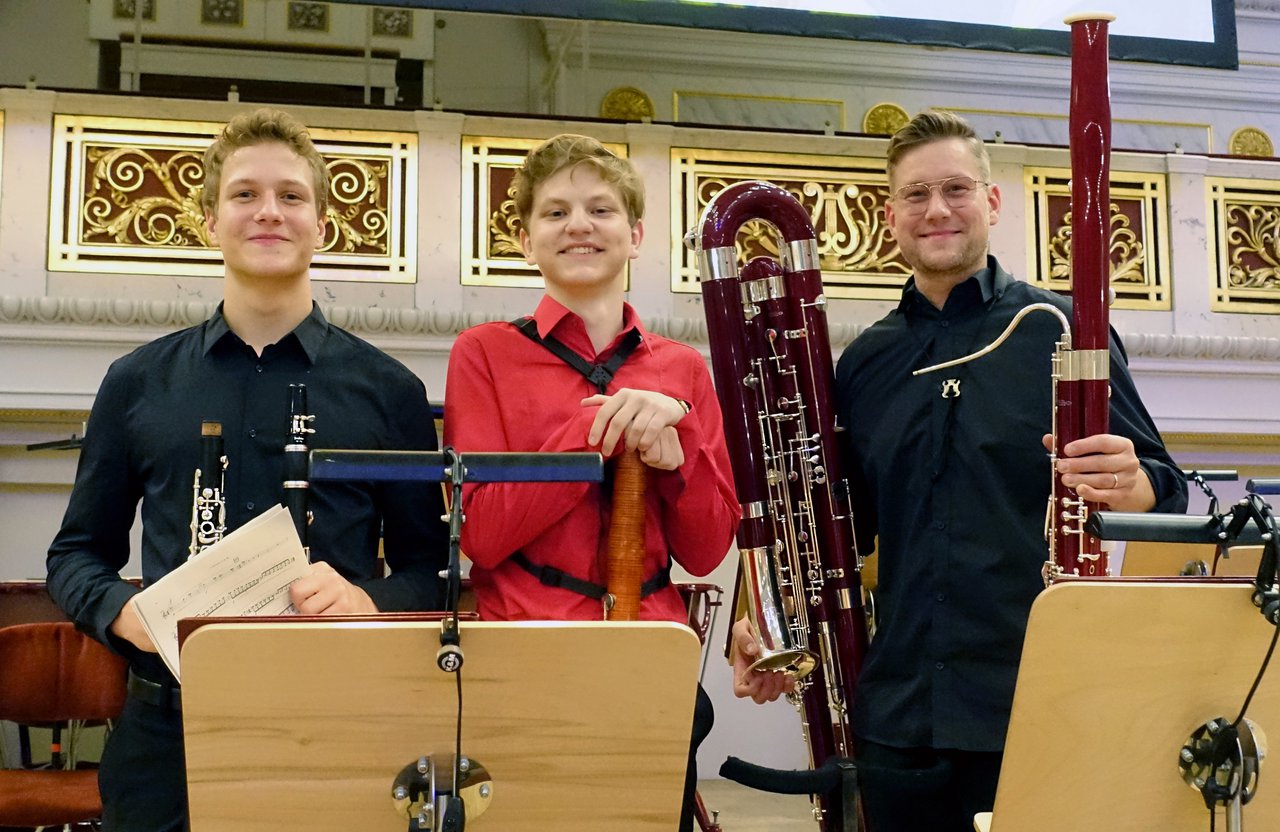 Tutti Pro-Konzert 2023: Fagottist Alexander Kasper mit Nachwuchsmusikern © Norbert Möller
“Tutti Pro” s a joint initiative of Jeunesses Musicales Deutschland and unisono, in which professional orchestras coach members of outstanding youth orchestras. The Berlin Konzerthaus Orchestra has collaborated with the orchestra of Berlin's C.Ph.E. Bach Music High School for many years. Each season, the orchestra members thoroughly coach the young musicians and then play a symphonic concert together in the Große Saal. We talked to Norbert Möller, principal bass clarinetist, and his student Louis Sturm about the project.
“The close connection between the Konzerthausorchester Berlin and the Carl Philipp Emanuel Bach Music High School goes back decades, when our orchestra was still called the Berliner Sinfonie-Orchester and the school was a special school for music in the GDR. The instrumental teaching was primarily provided by orchestra colleagues, including some from our orchestra. Quite a few of the graduates now play with us or have found their way into other renowned orchestras.
I myself was a student at this school in the 1970s, and I have now been teaching clarinet, chamber music, and orchestral playing there for decades. I consider myself fortunate that my students will be sitting next to me at this concert.“
Right now, he is particularly proud of one of them: “Louis Sturm is taking his high school diploma at Bach Gymnasium, has won the Jugend musiziert competition, among other things, and was invited to play at the prize winners' concert, which was broadcast live by NDR. He will be playing the solo clarinet at the concert on January 16—the program includes Richard Strauss's Rosenkavalier Suite. He played his very first clarinet notes with me. Now, after hundreds of intensive lessons over nine years and an estimated 7,000 hours of individual practice, he is one of the best young musicians in the country.”
When Louis Sturm is told about his teacher's praise, he smiles a little shyly. “I decided to go to Bach Music High School because I already knew that I wanted to play the clarinet a lot. Besides, my siblings had already attended the school. My older brother Fabian went on to study the cello and was a member of the orchestra academy of the Konzerthausorchester last year.” Anyone who wants to study music intensively and doesn't mind taking exams every six months in his minor such as piano and aural training as well will be in very good hands there, “regardless of whether you want to study music later or not.”
This isn't Louis's first Tutti Pro concert. He played one two years ago – our cover photo is from a rehearsal. What was that like? “You learn a lot from the orchestra musicians. You also spend time with them in the tuning room and get to know each other very well. The atmosphere is really good.” Louis has played not only in the Bach Gymnasium symphony orchestra, but also in the federal state of Berlin youth orchestra and the German national youth orchestra. What are the differences for him between playing with excellent youth orchestras and playing with professionals? “I think the biggest difference is that in the first rehearsals, everyone already has a complete mastery of the score. You can get straight down to the real orchestra work.” Is he more excited than in a youth orchestra? Louis laughs: “Yes, of course, absolutely!”
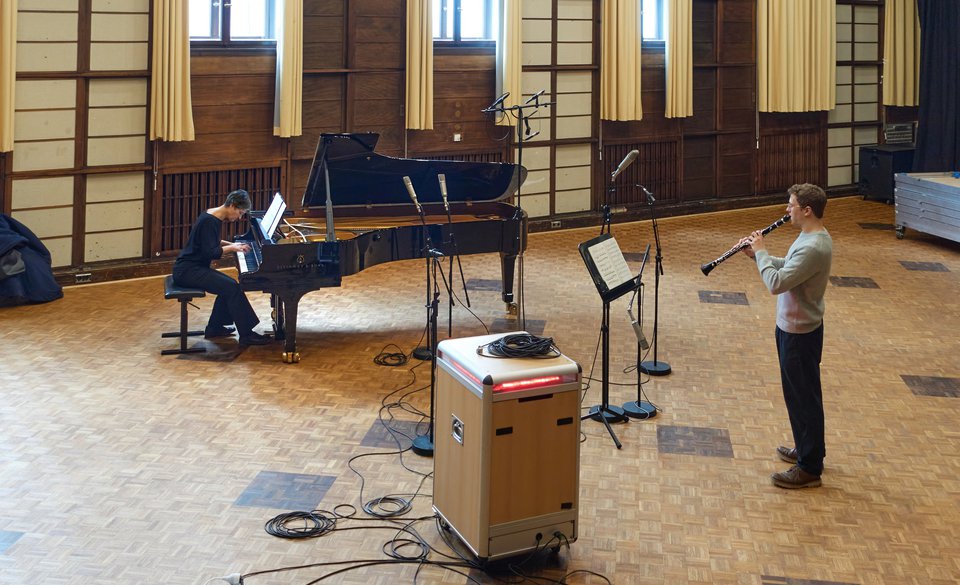
Louis Sturm during a radio recording after having won a competition. Photo: Norbert Möller
When asked what young musicians are learning during their preparations for the Tutti Pro concert, Norbert Möller immediately thinks of an example that fits Louis' assessment: “A colleague who was preparing a young musician for a past concert was initially shocked that, 14 days before the concert, the youngster still had to look at the notes instead of being able to concentrate on playing together and on the interpretation. For the student, that realization was beneficial. If someone is planning to pursue this career, it is good to get an impression of what everyday life in an orchestra is like beforehand. This includes not rehearsing a piece over and over again as in a youth orchestra, but having to put it together in three days. It is also very important that the students get an initial idea from the professionals who play next to them about how much they need to play up in order to be heard in a concert hall like our Großer Saal.”
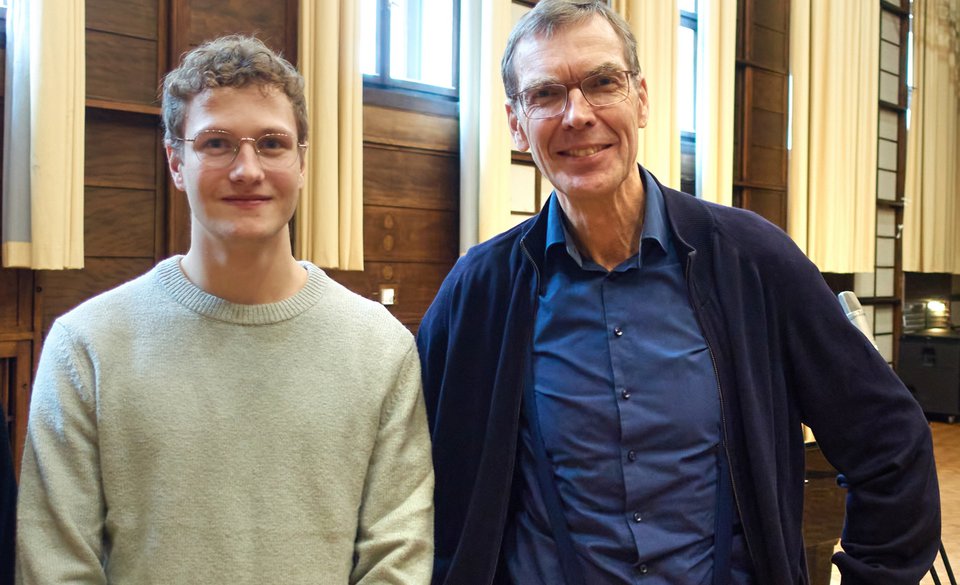
Young clarinet player Louis Sturm with his teacher Norbert Möller
“I always say that I learned a lot from my professor, born in 1915 – namely, how I don't want to do things. I get to know the children in fifth grade and teach them until 13th grade. That makes me a kind of life coach, and I often have more insight into their lives than their parents do,” Norbert replies when asked what has changed in human terms compared to his own school days. “I try to be the kind of person who gives these young people food for thought. When a student told me he wanted to drive a BMW 5 Series when he grew up, I said I even had 8 gears – as a passionate cyclist!
I am always there for my students. With the youngest ones, of course, everything is still very school-like. There are phases where I have to be available a lot. And others, especially with the older ones, where the process is already relatively student-like, and I just suggest which piece we could tackle next. Of course, I go to all the competitions with them.”
Sometimes, it's also about everyday things: “The other day, my youngest student was stranded at the Brandenburg Gate because of a demonstration. It was pouring rain. I picked her up and my wife took care of getting her some dry clothes. We had a rice waffle with honey, something hot to drink – and then we had a serious lesson.”