13.00 Uhr
Rundgang
Share


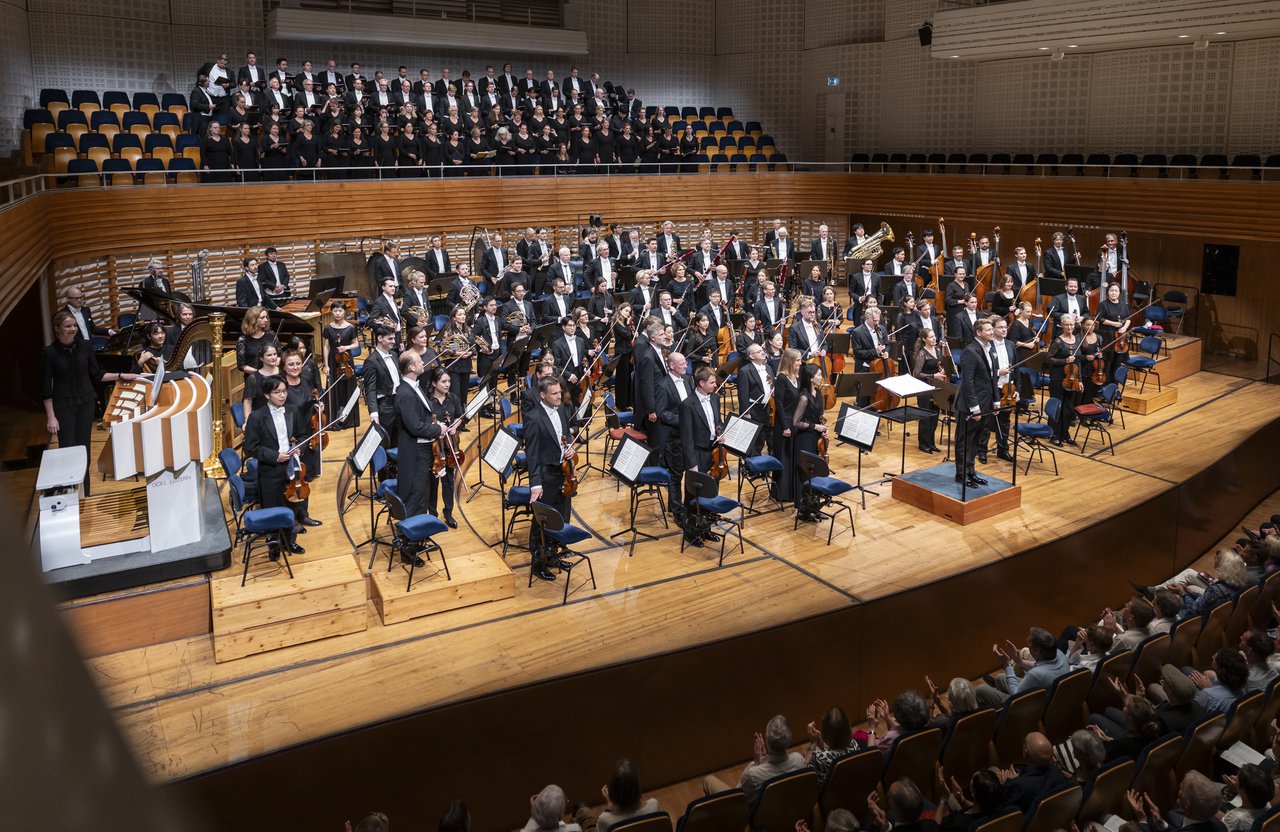 KHO & Rundfunkchor Berlin mit Duncan Ward im KKL Luzern © Patrick Hürlimann/Lucerne Festival
“What do we need to do to get a lake like this behind our house?” Our first guest performance at the Lucerne Festival left us completely thrilled – by the perfect acoustics in the KKL Luzern concert hall as well as by the picture-perfect Swiss setting of lake and mountain panorama.
Photos: KHB (musicians); Ralf Forster (KKL)
Having arrived from Zurich, Sayako Kusaka stored her precious violin safely at the hotel and headed out onto the lake with us. We made a leisurely boat trip in the afternoon sun and pondered which little cottage, up on the slopes or down by the shore, we’d most like to move into – our favourite was in a little village called Kastanienbaum, right next to the jetty. After that, however, our first concertmaster headed back to the hotel to practise.
Our cellist Jae Won Song has known Lucerne since 1986. Back then, as a 14-year-old, she travelled from Seoul with her cello teacher to attend a masterclass: “The KKL didn’t exist back then; the course took place at the conservatoire.” However, there are two local specialities she has only just tried: Luzerner Birewegge, a strudel with dried pears, plums and nuts – and ‘Rivella’, Switzerland’s undisputed favourite soft drink. Both were recommended to her by Swiss fellow cellist Nerina Mancini, who studied in Basel. She recalls her time working with the Gustav Mahler Youth Orchestra: “We were based up on the Bürgenstock and travelled down into the city every day for rehearsals.” She used her free afternoon to visit Lucerne’s local mountain, the Pilatus, “for the very first time”.
Photos: Ralf Forster
After mountain hike and boat trip, the next morning was, of course, all about music for everyone: a last rehearsal for Henze’s 9th Symphony at the Lucerne Culture and Congress Centre, which is a very special place:
Two canals run through it on the ground floor; a huge roof juts out far beyond the building towards the lake, whilst the wood-clad outer wall of the concert hall curves towards the viewer like a cello case. The building by architect Jean Nouvel that opened in 1998 next to Lake Lucerne is full of surprises, both visually and acoustically. The noise level in the concert hall is 18 decibels, according to the venue’s own description – this corresponds to “the sound of the forest and is inaudible to the human ear within the normal frequency range”. So, there's a profound silence, which is a wonderful condition for listening to a piece of music in its full dynamic range – both in the hall and on the stage, which is equipped with a special sound reflector called canopy.
The piece the Konzerthausorchester made its debut in tranquil Lucerne is truly anything but that: Hans Werner Henze, who would have celebrated his 100th birthday this year, wrote his Ninth Symphony in 1997 “as an apotheosis of the terrible and the painful” in memory of and in honour of those who gave their lives in the resistance against fascism.
The Konzerthausorchester, featuring a large line-up including, amongst others, nine percussionists, an organ and rare instruments such as the contrabass clarinet and the heckelphone, the Rundfunkchor Berlin, and conductor Duncan Ward deeply impressed the festival audience with their performance on Monday evening.
Photos: Patrick Hürlimann/Lucerne Festival