13.00 Uhr
Rundgang
Share


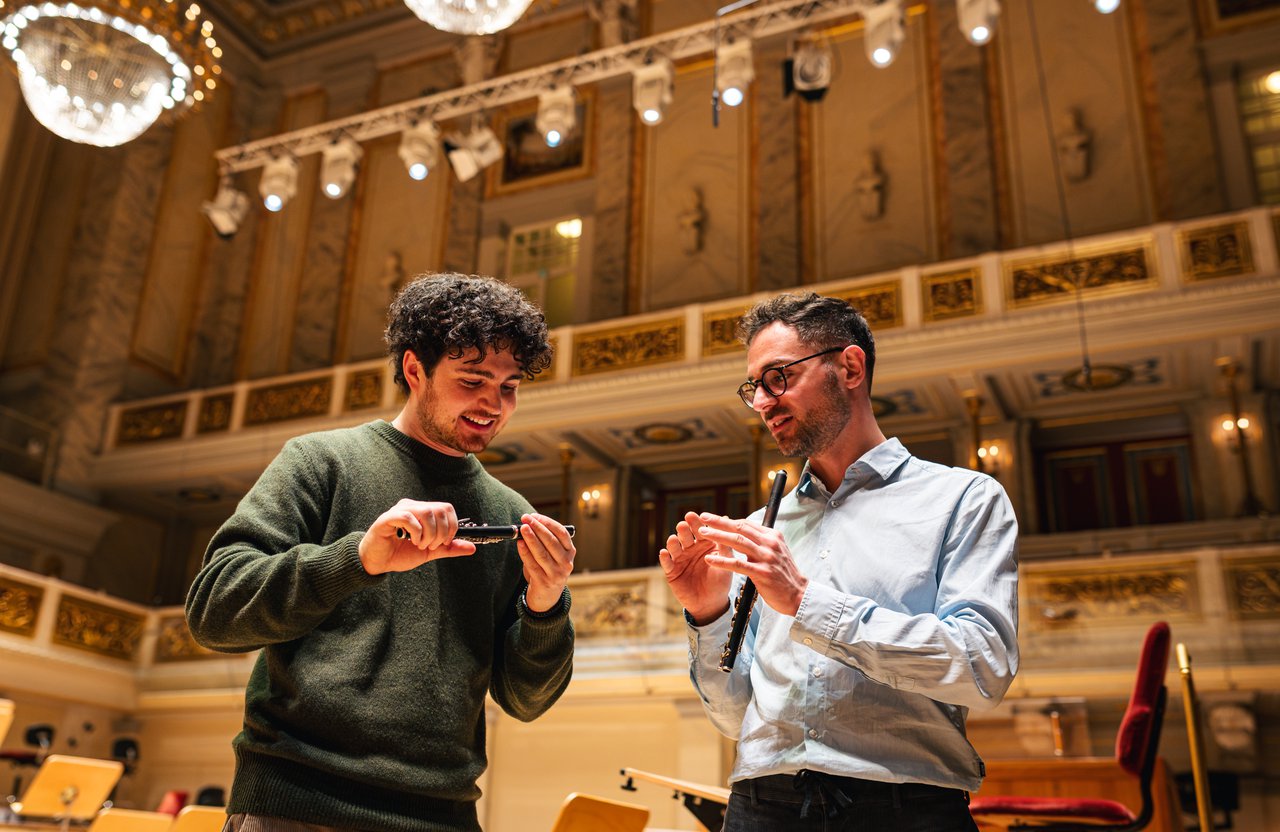 Genauer Blick aufs Piccolo-Kopfstück – Mentor Daniel Werner (re) & Akademist Giorgio Bani © Andreas Antoni
Those who earn a place at our orchestra academy are usually nearing the end of their music studies and have always mastered their instrument to a exceptionally high standard. In the Konzerthausorchester, scholarship holders gain an insight into the day-to-day reality of their future profession. One question that always comes up is: where do auditions for orchestra positions take place?
Every piccolo, small as it is, has its own character. Giorgio Bani (academy member flute 2024–26) meets with his mentor Daniel Werner, our principal piccolo player, in pursuit of the perfect instrument. They try out the sound of the instruments in the Great Hall, as that is where the music is usually performed – from Vivaldi’s Concerto in C major to the evocative piccolo passages in Shostakovich’s symphonies.
This is how Daniel Werner sums it up. “It’s very important to blend well with other instrumental sections – from the strings to the trumpets. In the upper register, we often have the challenging task of bringing the overall sound together. In the orchestra, the line-up changes every week, even just within the flute section. How do I blend in tonally whilst still maintaining my presence? That’s what our mentors are there for.”
For Giorgio Bani, the fact that, as an academy member, he gets to know many conductors plays a major role: “Mahler’s Fourth was on the programme twice in quick succession, in two very different interpretations. I was also lucky enough to play works featuring key audition passages for the second flute, such as Dvořák’s Ninth or Ravel’s ‘Daphnis and Chloé’. This experience is absolutely brilliant for auditions. And hearing the other flutes so close by always gives me a real boost of motivation. I always think to myself, ‘Wow, I want to be able to do that too!’”
Violist Nilay Özdemir was herself a scholarship holder at the Kurt Sanderling Academy: “As a student, you have the luxury of plenty of time to prepare for concerts. When I became a member of the academy, I was faced with a succession of major works. I had to learn to plan and decide quickly what was most important at any given moment.” You only really grasp the internal dynamics between the group, musical freedom, presence and restraint once you’re actually in the orchestra, she explains.
Nilay now passes on her experiences as a mentor. “The time at the orchestra academy is very ‘demanding’, particularly because of the many auditions. Even our joint audition training sessions, which are also attended by orchestra members, are a challenge for the academy members.” Her mentee Joon Hurh (academy member viola since 2025) agrees, but exudes a sense of calm:
He shrugs his shoulders. “At first, I didn’t believe it. That’s changed. You can prepare, play well and hope to be the best, but you can’t really control it. The more auditions you do, the less you dwell on each one. Sometimes you play well, get very good feedback from the viola section – and then, unfortunately, the orchestra has different tastes.” It takes a lot of patience to make it into a symphony orchestra.