13.00 Uhr
Rundgang
Share


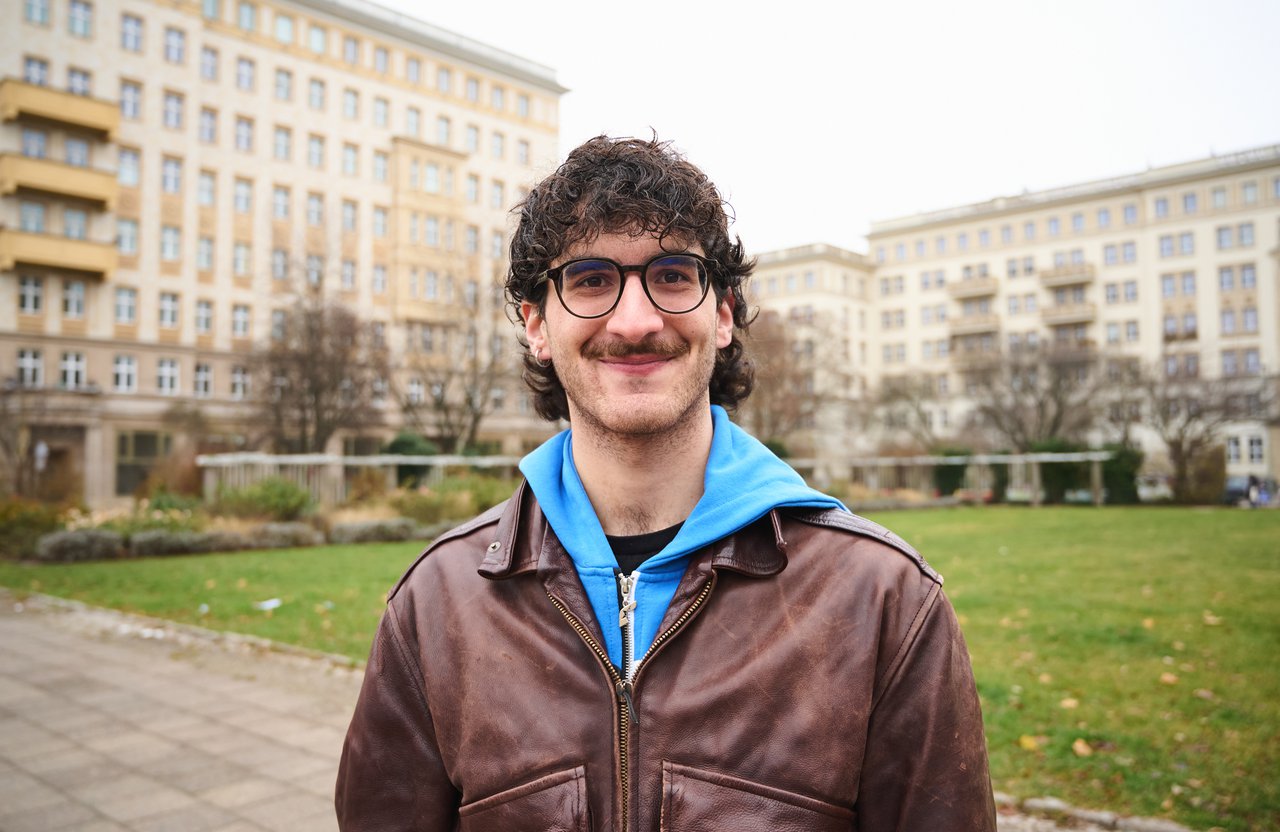 Kiezspaziergang mit Giorgi Gigashvili © Andreas Antoni
Before they come to us, we visit them in their neighbourhoods: the musicians of our new series “Tracks – Music of the City at the Konzerthaus.” Before the second episode, we met with Giorgi Gigashvili in Friedrichshain near Karl-Marx-Allee at his favourite place. The pianist, who comes from Tbilisi and now lives in Berlin, invited us to his closest friends' shared flat. Between a cozy, crumpled leather sofa from the flea market and the mini recording studio in a friend's room, Giorgi talks about his Berlin and the “Serious Music” programme, which he will bring to the Konzerthaus on January 10 with Nikala Zubiashvili (live electronics & synthesizers).
“I've been going from place to place for some time in Berlin. Besides, I'm often away for concerts. My own rented flat in Prenzlauer Berg is not really home. So I asked you to come to the shared flat of friends with whom I'm very, very close. Among them is Nini. She is one of my best friends and and a musician as well. Her place is my favourite place in Berlin to hang out and to work together. There is a tiny studio in her room. The people here are the reason why I love Berlin so much. More than with the infrastructure or the cultural things or or clubs, the city is associated for me with these close friends from Tbilissi. In that sense, Berlin is like my second home.”
“Being very classical and very not classical is both very much rooted in me. I'm not a person who only wants to play Beethoven concerts. Each project, whatever it is, is very sacred to me. I don't do anything when I'm not expressing myself 100 per cent through it. There is no other way to be an artist, to be called an artist. You have to be very honest with what you do. I'm very honest in in my classical piano playing and also in making electronic music with Nini, or with Nikala. We trust each other completely and learn many things from each other. For me, music means to express yourself and to share something very personal. That's also the reason why we are friends with someone: to express ourselves and to share something that's deeply connected to oneself.”
“With Nikala, I'm responsible for finding the pieces as well as for the arrangement. First, we listen to the original orchestral piece. Then, we discuss what sound or what beat we have in mind when we are listening to it. The process is very hard and sometimes exhausting, because I have to explain everything I want to Nikala, and he has to explain to me how to make things work. Debussy, for example, is very tough to orchestrate through electronic music because of the voicing. But it's also immensely interesting to make it work when you love the piece itself and very much worth it. Or take Ravel's Bolero: One theme is repeated 12 times, 20 times, and it's always interesting what sound will be added next. We didn't want to use orchestral sounds people know already, like violins or flute, but electronic sounds only. We did a lot of research. Bolero is very well known for its drums, so we added electronic beats. It was so interesting to dive into it and create the full sound with only one computer and one pianist instead of an orchestra of 70 musicans.”
“I'm so happy to present our ‘Serious Music’ programme here in Berlin because this is the place where I got the idea to do electronic music infused with what I think I can do best – classical music. It is one of the projects I'm very proud of and the kind of thing I always wanted to do. With Nikala, this dream now comes to life: to show that classical music can be a electronic and vice versa. I think classical music should be interpreted as a modern genre - I want to introduce it that way to my generation, who often think that it is boring.
Besides Ravel's Bolero, there will be Prokofjew's Piano Sonata No. 7, Beethoven's Ode to Joy and many more, infused with other music. We will also play Georgian music – Georgian classical music from 19th century as well as folk music, which goes back to the Seventh century, but in a very modernized and electronic way. It's important to play folk music to keep it alive. Every composer should do something with folks songs, I think. The last who did it was Bela Bartók, to really educate himself and learn about the roots of Hungarian music. For me, it is natural: I've been singing singing folk music from the age of four.”
After our talk, we took a short walk through the neighbourhood in the drizzling rain and showed Giorgi the famous “Kosmos” building, a former cinema from the GDR era. The pianist is an enthusiastic about films:
“When I'm playing, I always imagine something visual. After my music, films are my next biggest obsession. For me, they are the way to to see what's going on in a filmmaker's head! I'm so interested in how director visualizes something to match their feelings.
One of my favourite buildings in the city is the Filmtheater am Friedrichshain, which is so raw and really Berlin. It's my favourite place to watch great films like those of the Greek director Yorgos Lanthimos. Inside, there is this very beautiful golden curtain and these yellow chairs in one of the halls. You think you are part of the film when you are there. I also love watching and discussing films with my friends. It often gets very intense.”