13.00 Uhr
Rundgang
Share


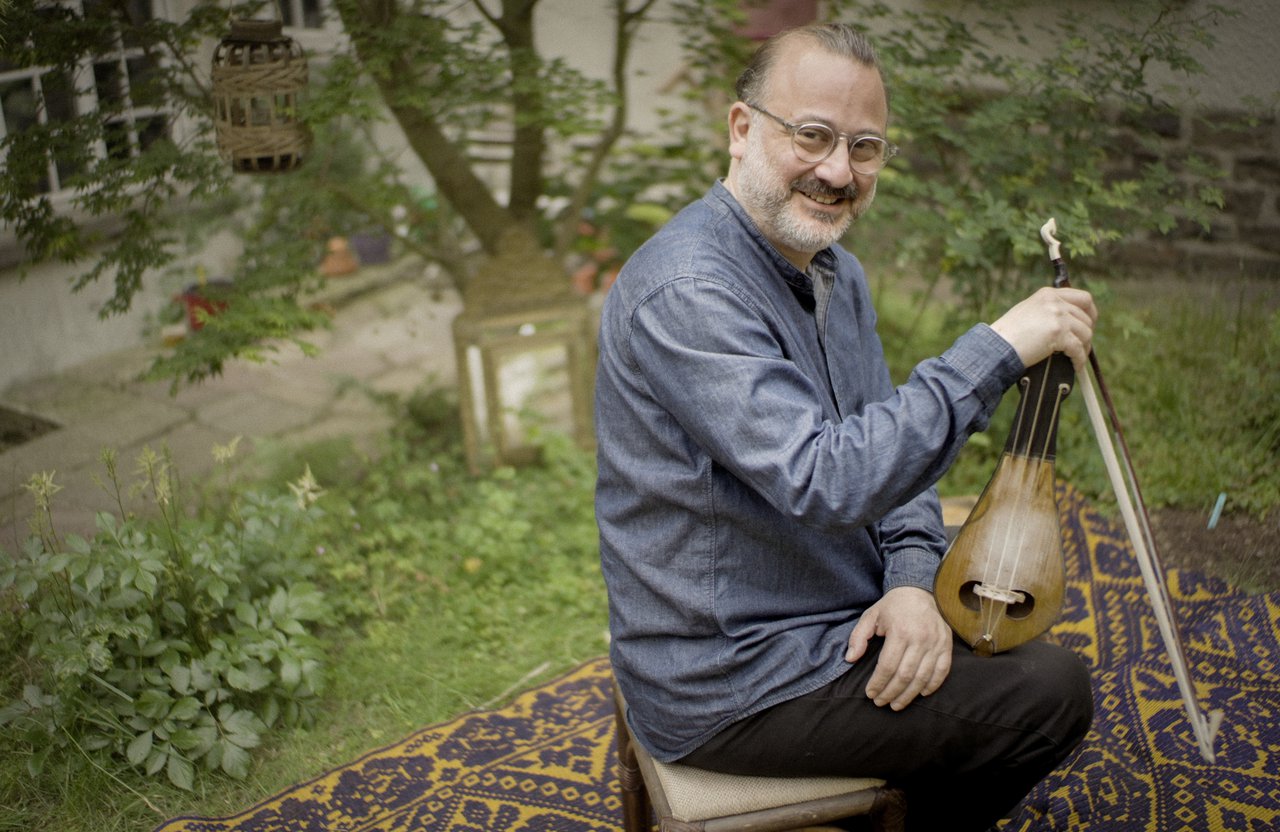 Derya Türkan © Farah Kassem
Between the Euphrates and the Tigris lies one of the world’s oldest musical landscapes, which shares both a rich heritage and living traditions.
In the second installment of our Aşina series, kemençe player Derya Türkan and his ensemble will bring “The Sounds of Mesopotamia” to the Small Hall through traditional melodies and improvisations. We spoke with him about it.
The Mesopotamian region covers a very vast geographical area. This region is also multicultural, and it is this very characteristic that makes it exceptionally rich. Many ancient civilisations flourished in this region and enriched human civilisation. This richness naturally fostered the development of music and gave rise to a vast musical repertoire within folk culture.
In this project, I wish to present examples of all the folk music traditions that have flourished in this region in particular. I am therefore delighted to have the opportunity to showcase each of these cultural treasures. I plan for the programme to begin with a Hurrian hymn dating from the pre-Christian era, with the subsequent pieces reflecting the evolution of these traditions.
As you know, Mesopotamian culture has influenced not only the region in which it originated but also Europe. I would describe the region’s music as follows: modal music evolved over time, and the distinctive tones of the modal system enhanced its expressive power. European music, in turn, incorporated this influence into its own cultural context, thereby enriching its musical tradition. For example, although not exactly the same, the seven-note diatonic scale used in Mesopotamia can be seen in modern music.
Yes, I was lucky enough to be born into a family of musicians. Although it’s both easy and very difficult. The easy part is that I’ve known many important musicians since my early years, but when I eventually became their pupil, I found myself challenged by the artistic depth and difficulty involved. The Istanbul kemenche entered my life when I was 11; it was an instrument whose sound I’d heard before, but whose depth I hadn’t yet realised. It was only when I listened to my master and had the honour of becoming his pupil that I truly understood it, and it became a part of me. Because, in truth, I fell in love with the sound my master created.
Überlieferte Melodien und Improvisationen zwischen Euphrat und Tigris